
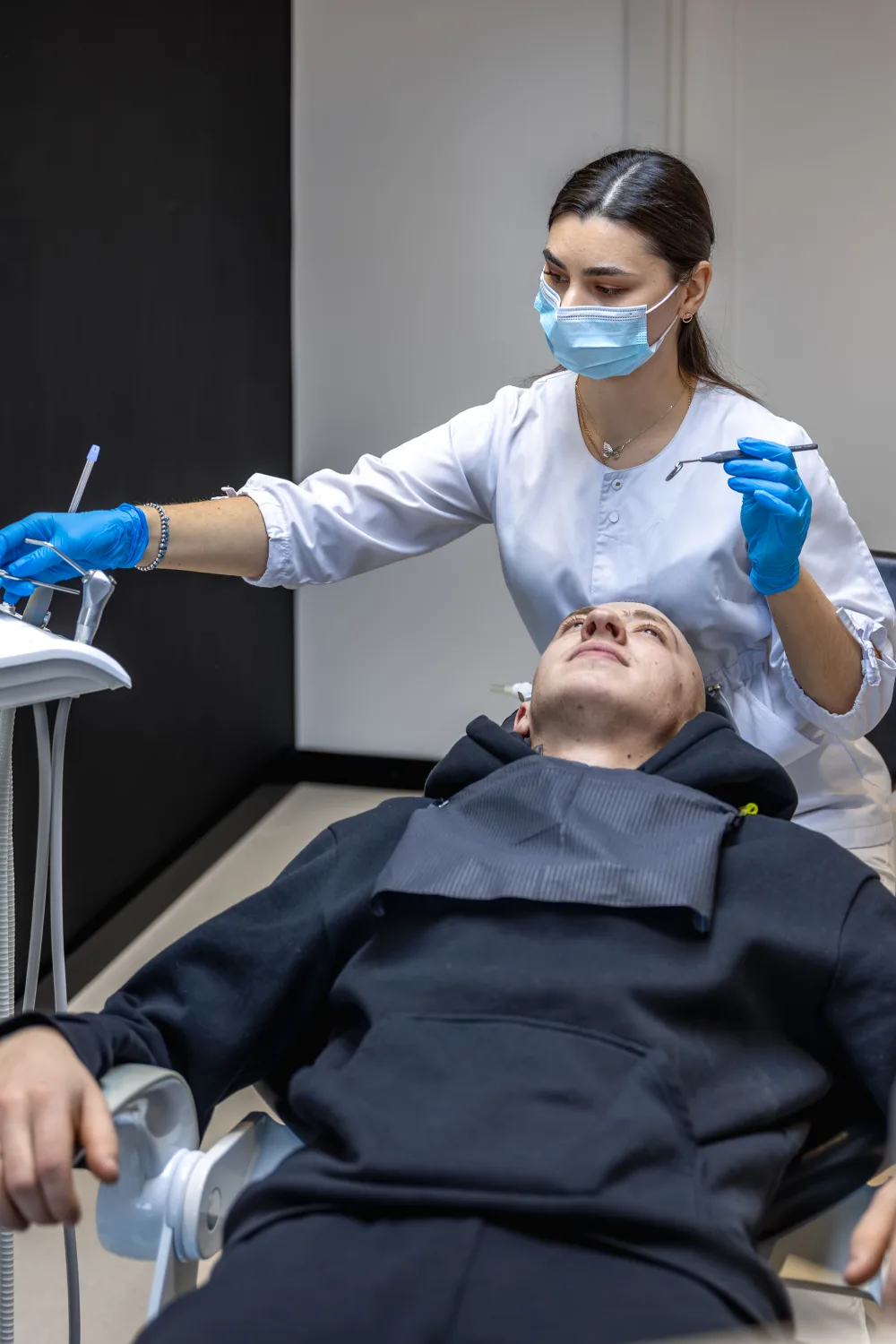
Scaling and root planing during a periodontics treatment
Home Periodontics

Stop the disease affecting your gums. Periodontics in Fuengirola and Maqueda

Stop bone loss before it becomes irreversible.

Periodontitis gradually destroys the bone that holds your teeth in place, almost always without pain. At Dentaláser we measure the real condition of your gums with periodontal probing and, if needed, treat the infection with scaling and root planing before bone loss becomes irreversible. Diagnosis included in your free first visit.

Free
Periodontal diagnosis
at your first visit
Gingivitis
Inflammation limited to the gum
Bleeding when brushing or flossing
Reversible with professional cleaning and daily hygiene
No bone loss
Periodontitis
The infection advances below the gum, inside the periodontal pockets
Destroys the bone and ligament that support the tooth
Can cause tooth mobility and, without treatment, tooth loss
Has no spontaneous cure; it is controlled with scaling and root planing
PERIODONTAL DISEASE

Gingivitis and periodontitis
are not the same.

Both start the same way: bacterial plaque that isn’t removed and inflames the gum. The difference lies in what happens next. Gingivitis stays in the gum and is reversible with cleaning and hygiene. Periodontitis advances below the gum line and, without treatment, does not recover on its own. According to the Spanish Society of Periodontology (SEPA), 8 out of 10 Spanish adults aged 35 to 74 have some degree of periodontal disease, and almost half don’t know what periodontitis is.

38%
of the Spanish working population over 35 has periodontitis, a share that rises above 50% from age 45, according to a study backed by SEPA and the Complutense University of Madrid
2M
of adults in Spain have severe periodontitis, out of the 8 million who have some form of periodontal disease, according to the General Council of Dentists of Spain
🔬
Early diagnosis makes the difference Periodontitis doesn’t usually hurt until the damage is already hard to reverse. That’s why periodontal probing at your check-up, not just pain, is what shows whether your gums are healthy.
SIGNS TO WATCH FOR

The symptoms of periodontitis
don’t always hurt.

The absence of pain is why many patients come to us too late. These are the signs that your gums need a check-up.

🩸
Bleeding gums
When brushing, flossing, or even spontaneously. It’s the first sign of gingivitis and the easiest to ignore.
🔴
Red or swollen gums
A healthy gum is pale pink and firm. Redness and swelling indicate active infection.
💨
Persistent bad breath
Doesn’t improve with brushing or mouthwash. Bacteria under the gum produce compounds with a distinctive smell.
📏
Gum recession
Teeth look longer because the gum pulls back and exposes the root, often with sensitivity to cold.
⚠️
Pus or abscesses
When pressing the gum, between tooth and gum. It’s a sign of active infection that needs attention.
🦷
Tooth mobility
Teeth feel loose or shift position because the bone that supports them has been reduced. It’s the most advanced sign.
TOOTH MOBILITY

Mobility is measured in grades using the Miller scale, commonly used in clinical periodontics. The higher the grade, the more advanced the bone loss tends to be.

Grade 0
No detectable mobility. Firm tooth.
Grade 1
Horizontal movement of less than 1 mm.
Grade 2
Horizontal movement of more than 1 mm.
Grade 3
Mobility also in the vertical direction; the tooth gives slightly under pressure.
PERIODONTAL DIAGNOSIS

We measure, we don’t guess.

Diagnosing periodontitis isn’t based on how you feel, but on objective measurements. At your free first visit, periodontal probing uses a millimetre-marked probe to measure the depth of the groove around each tooth: up to 3 mm is considered healthy or gingivitis, while a greater depth can signal active periodontitis. The definitive diagnosis, according to the American Academy of Periodontology (AAP) classification, is not based on a single measurement: it also assesses clinical attachment loss across several teeth and, if needed, we complete it with X-rays to see how much bone has been lost around each root, something that can’t be seen with the naked eye.
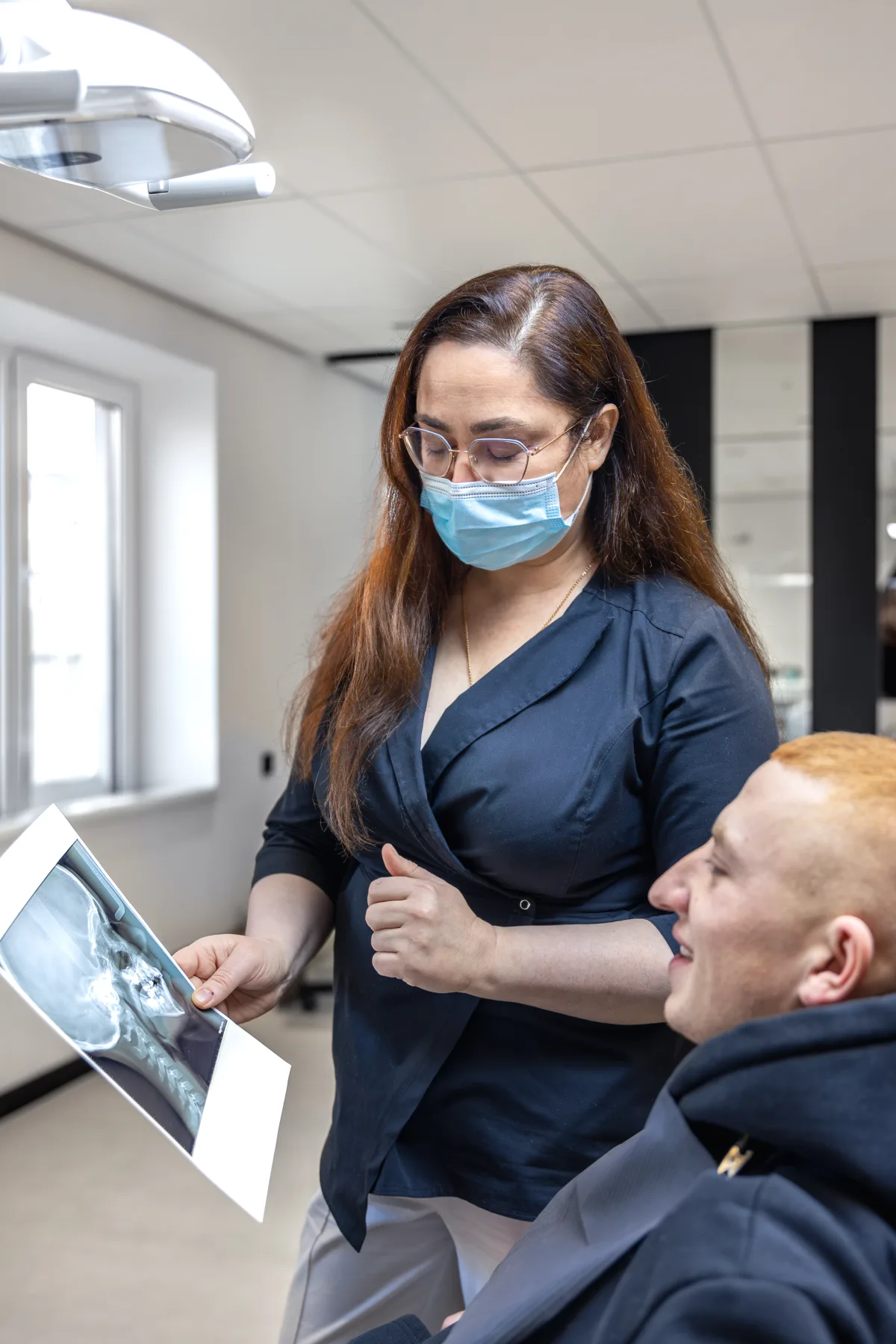
Periodontal probing at several points per tooth
Recording of bleeding on probing
X-rays when bone loss is suspected
Assessment of tooth mobility
Treatment plan based on the degree of involvement
Periodontal diagnosis with X-ray at Dentaláser Fuengirola
>3 mm
of probing depth can indicate active periodontitis
TREATMENT

Scaling and root planing:
the treatment for periodontitis.

Once probing confirms periodontitis, the treatment is scaling and root planing, also called deep cleaning. Unlike a maintenance dental clean (see the full comparison in hygiene and prevention), scaling and root planing works below the gum line, inside the periodontal pockets, to remove the plaque and tartar causing the infection and smooth the root so the gum can reattach.

1
Diagnosis
Periodontal probing and, if needed, X-rays to confirm the degree of involvement and the areas to treat.
2
Local anaesthesia
Local anaesthesia is applied to the area being treated. You shouldn’t feel pain during the procedure.
3
Scaling and planing by quadrant
We work quadrant by quadrant: subgingival tartar is removed with ultrasound and the root is smoothed with hand curettes. Usually in one or two sessions, depending on how many quadrants need treatment.
4
Follow-up review
A few weeks later we review how the gum has responded and assess whether maintenance is enough or another step is needed.
AFTER TREATMENT

Periodontitis can be controlled.
It doesn’t heal on its own, but it can be stopped.

Lost bone doesn’t regenerate on its own, but with the right treatment and consistent maintenance, the disease stops and the teeth are kept for years.

1-2d
Expected sensitivity
AFTER TREATMENT

It’s normal to notice sensitivity to cold or mild discomfort in the first days after scaling and root planing. It’s managed with everyday painkillers if needed.

3-4m
Periodontal maintenance
THE FIRST YEAR

After active treatment, the first year requires more frequent check-ups than a standard clean, to stop the infection reappearing in the treated pockets.

Daily
Care at home
YOUR PART OF THE TREATMENT

Correct brushing, interdental brushes or floss every day, and not smoking. Smoking multiplies the risk of periodontitis progressing even with treatment.

FREQUENTLY ASKED QUESTIONS

What we’re asked most
about your gums.

Dentaláser clinical team · Clinical direction: Dr Alberto Cerezo · Updated: 2 September 2026

If you have more questions, call us on 952 46 67 33 or book an appointment. The periodontal diagnosis is included in your free first visit.

Gingivitis is gum inflammation that is reversible with professional cleaning and good hygiene. Periodontitis is what it becomes when left untreated: it destroys bone and gum tissue irreversibly. More detail in Gingivitis or periodontitis: how to tell them apart
You shouldn’t feel pain during the procedure: it’s carried out with local anaesthesia in the area being treated. In the following days some sensitivity to cold or mild discomfort is normal, which is managed with everyday painkillers and fades gradually.
Periodontitis has no cure in the sense that bone already lost doesn’t regenerate on its own, but it can be fully controlled with treatment. Left untreated, the disease keeps progressing: supporting bone keeps being lost, tooth mobility increases, and the tooth can eventually be lost. With scaling and root planing that infection is stopped and progression is halted, so the earlier it’s diagnosed, the less bone is lost before it’s brought under control.
Bleeding is the first sign of active gum inflammation, almost always from a build-up of bacterial plaque. It’s not a sign that you should brush less, but that you need to brush better and complete your hygiene with floss or interdental brushes. If bleeding persists for more than one or two weeks despite good hygiene, it can indicate periodontitis and it’s worth us reviewing it.
It depends on the grade and the cause. If mobility is due to active inflammation, periodontal treatment usually reduces it by stopping the infection and reducing inflammation in the supporting bone. In advanced cases, with significant bone loss, mobility may not fully reverse, but treatment remains necessary to keep the tooth for as long as possible. We can only give you a real prognosis after an examination.
No. A dental clean (scale and polish) removes tartar above the gum line and is a preventive treatment for healthy mouths. Scaling and root planing works below the gum, inside the periodontal pockets, and is only indicated when periodontitis has already been diagnosed. You can check the full comparison between the two treatments on our hygiene and prevention page.
After active treatment, it’s usual to have more frequent maintenance than a standard clean, especially during the first year, when the risk of infection reappearing in the treated pockets is higher. The exact frequency, every 3, 4 or 6 months, depends on how your gum responds and is adjusted at each review.
FREE PERIODONTAL DIAGNOSIS AT YOUR FIRST VISIT

Don’t wait until a tooth
starts to move to come in.

We measure the real condition of your gums with periodontal probing and tell you, with no obligation, whether you need treatment. Call us: 952 46 67 33.

Free periodontal diagnosis
+30 years of experience
No waiting lists
Fuengirola and Maqueda
Call WhatsApp