
Why there's no single price for a root canal treatment
When someone asks "how much does a root canal treatment cost", the honest answer starts by explaining that the question itself doesn't have a single figure, in the same way there's no single price to "fix a car" without knowing which part is faulty. Root canal treatment removes the damaged or infected dental pulp from inside the tooth, cleans and disinfects the inside of its canals and seals them, but the difficulty of that process varies enormously depending on the tooth and its starting condition.
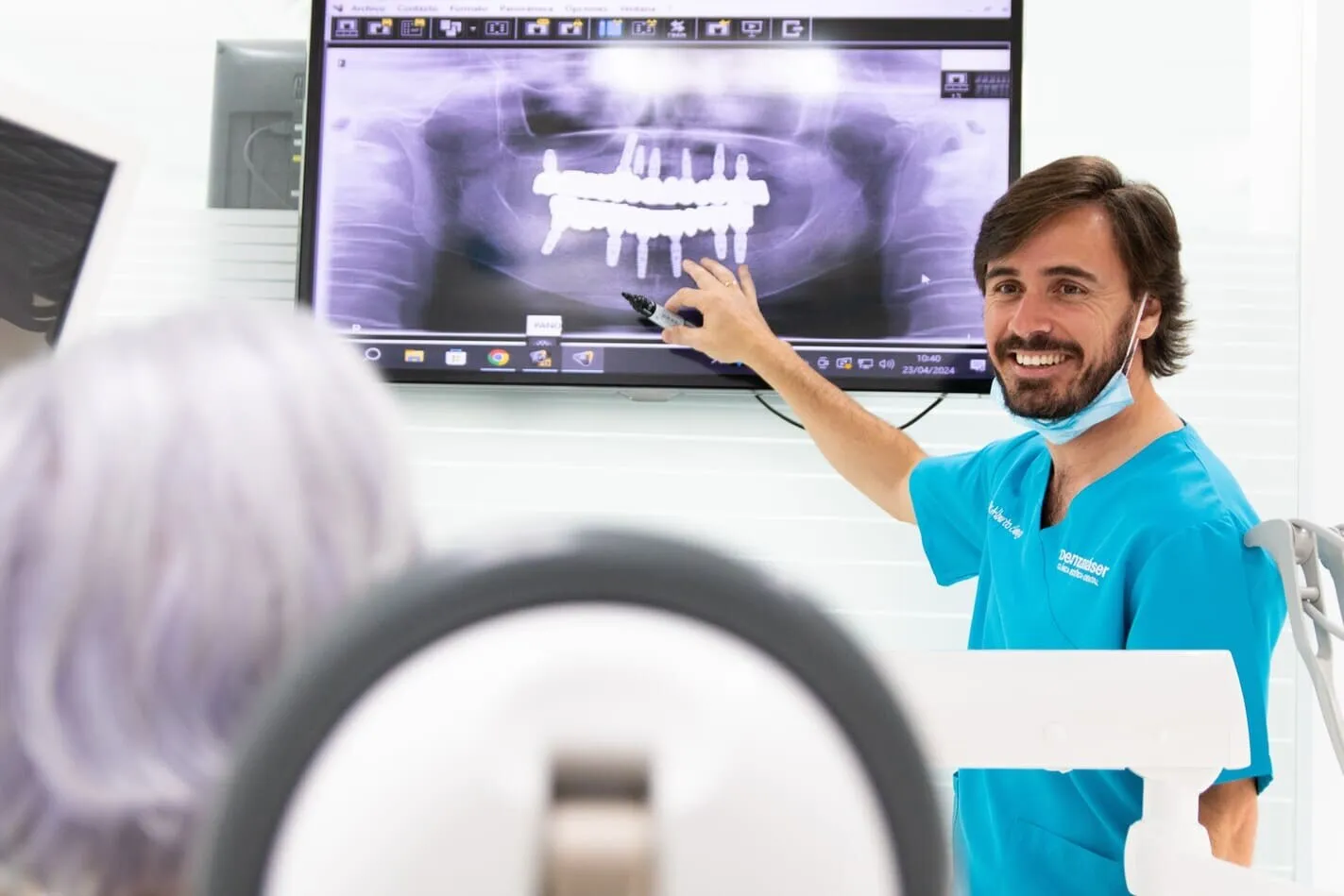
That's why, at Dentaláser, a root canal treatment quote is always drawn up after examining the specific tooth, with an X-ray or 3D imaging if necessary, and a generic figure is never given without having seen the case.
The tooth being treated: incisors, premolars and molars don't cost the same
By far the biggest factor affecting the price is how many canals the tooth that needs treating has:
- Incisors and canines: single-rooted teeth, with just one canal. These are the simplest and quickest treatments.
- Premolars: most are two-rooted, with two canals, which adds time and complexity compared with an incisor.
- Molars: multi-rooted teeth, with three or more canals and more variable anatomy. These are the longest and most technically demanding treatments, and therefore the ones that raise the price the most.
Most treatments are completed in one or two appointments lasting between one and two hours, depending on the number of canals: premolars and molars, with more roots, take longer than incisors and canines.
| Factor | Why it matters |
|---|---|
| Type of tooth | Incisor (1 canal), premolar (2) or molar (3+): the more canals, the more time and difficulty |
| Initial treatment or retreatment | Retreatment starts from a more complex case, with previous material that needs removing |
| Infection or complex root anatomy | May require more sessions or additional disinfection techniques |
| Final restoration of the tooth | Large filling or crown: quoted separately from the root canal treatment |
Complexity: retreatment, previous infection, root anatomy
Besides the type of tooth, there are complexity factors that can make the treatment more expensive whatever the tooth involved:
- Retreatment: when a previous root canal treatment hasn't resolved the problem or has failed over time, the material from the earlier treatment has to be removed before the canal can be cleaned and sealed again. It's technically more demanding than an initial treatment.
- A highly active infection: in cases with significant infection in the bone, an additional session may be needed to leave the canal medicated before the final seal.
- Complex root anatomy: canals that are very curved, calcified or have additional branches lengthen the working time and require more precision.
What's usually left out of the price of a root canal treatment (the restoration/crown)
One point that often causes confusion is assuming the root canal quote includes the tooth's final repair. It doesn't: the root canal treatment solves the problem inside the canal, but the tooth still needs a proper seal on the outside.
In front teeth with little structure lost, a filling is sometimes enough. But a tooth treated with root canal treatment loses part of its blood supply and becomes more fragile over time, so in molars and premolars — which bear more force when chewing — protecting it with a crown is usually recommended. That restoration, whether a large filling or a crown, is assessed and quoted as a separate treatment, not as part of the price of the root canal treatment itself.
- Check exactly which tooth is going to be treated, not just "a root canal treatment"
- Ask whether the quote includes the final restoration or not
- If it's a retreatment, confirm it: it usually costs more than an initial treatment
- Ask to have any complexity factors in your specific case explained to you
At Dentaláser the first visit is free and includes the diagnosis and a detailed written quote, with no obligation.